How to Use a Metronome for Guitar Practice
The guitar is arguably the instrument that benefits most from metronome practice, precisely because so many guitarists avoid it. Self-taught players, bedroom shredders, and even gigging musicians often develop timing habits that feel natural but are rhythmically inconsistent. A metronome is the corrective lens that reveals what your ears have learned to overlook.
Chord Changes
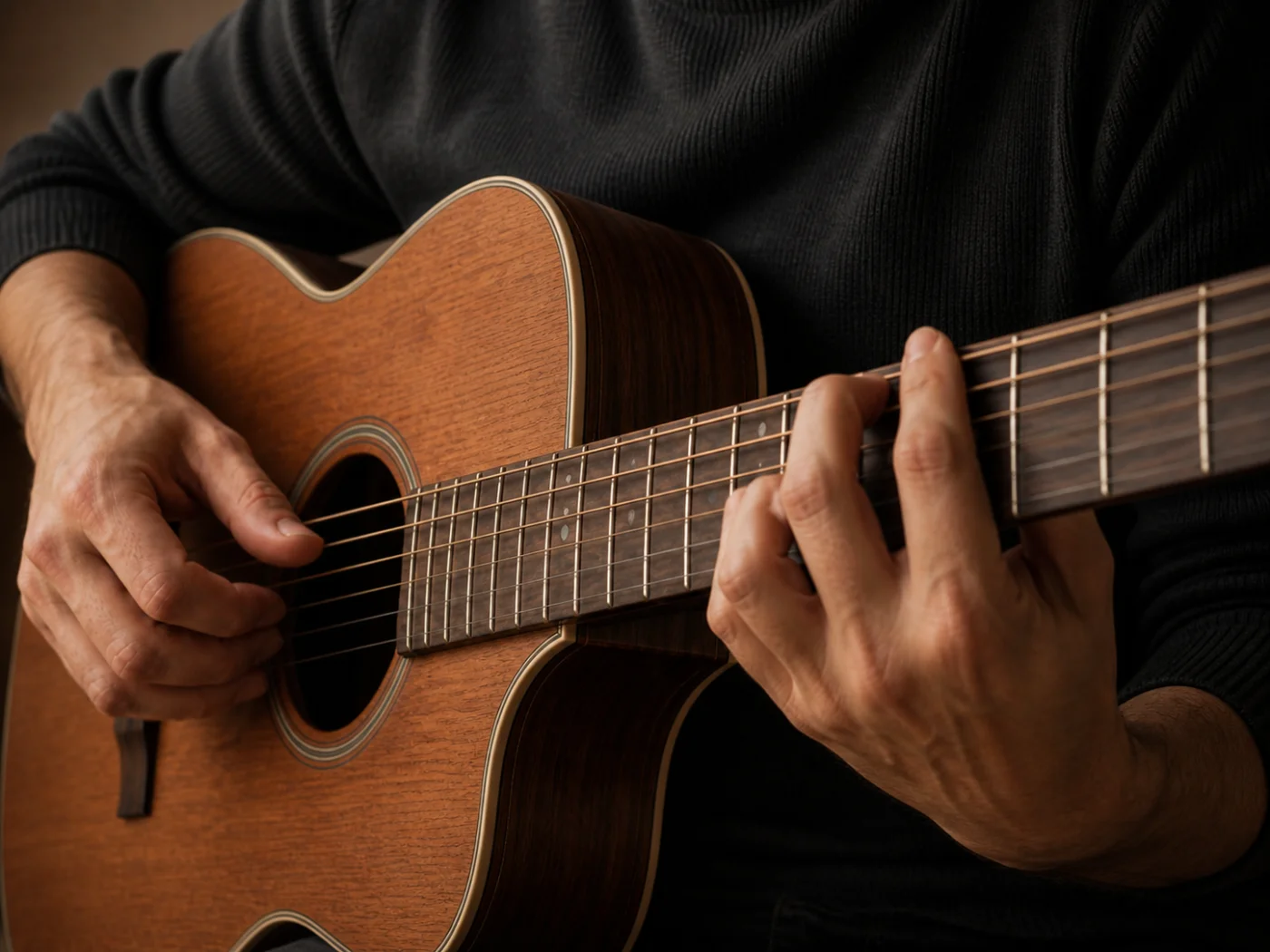
Clean chord changes — where the new chord sounds fully formed on the beat, not half a beat late — are the first thing a metronome fixes in guitar playing.
- Set the metronome to 60 BPM. Strum the first chord on beat 1. Let it ring for four beats. Change to the next chord exactly on beat 1 of the next bar.
- The change must be complete before the strum. If you hear muted strings or partial chords on the downbeat, your fingers are not arriving in time. Slow down until every change is clean.
- Common progression to practice: G - C - D - G. Then Am - F - C - G. Then Em - Am - B7 - Em. Each introduces different fretting challenges.
- Increase by 4 BPM only when four consecutive bars of each progression are perfectly clean.
Target tempos for chord changes: beginners should aim for clean changes at 80 BPM (one strum per beat). Intermediate players target 120 BPM. At that speed, your fingers are changing chords reliably in real musical contexts.
Strumming Patterns
The most common strumming error is not rhythm — it is inconsistent rhythm. A strum pattern might sound fine for 8 bars, then subtly shift for 4 bars, then shift back. A metronome exposes this drift immediately.
The Universal Strumming Rule
Your strumming hand moves in constant eighth notes — down on the beat, up on the "and" — whether or not it contacts the strings. Missed strums (where your hand moves but skips the strings) create the syncopated patterns that make guitar parts interesting. But the hand motion itself never stops or changes speed.
- Basic pattern (D-DU-UDU): Set metronome to 80 BPM. In one bar of 4/4: Down on 1, miss the "and" of 1, Down on 2, Up on the "and" of 2, miss 3, Up on the "and" of 3, Down on 4, Up on the "and" of 4. Your arm swings in constant eighth notes throughout — the missed strums are where your hand moves but skips the strings.
- Practice the arm swing without strings first. Your hand should move like a pendulum — steady, even, and unaffected by which strums are "real" and which are misses.
Fingerpicking and Travis Picking
Travis picking (alternating bass with thumb while fingers play melody on the treble strings) is one of the most metronome-friendly techniques because it is built entirely on rhythmic independence.
- Thumb alone first: Set the metronome to 80 BPM. Play alternating bass notes (root-fifth-root-fifth) in quarter notes, one per beat. The thumb must lock to the click with mechanical precision.
- Add fingers: At the same BPM, add index and middle fingers playing treble strings on the offbeats (the "ands"). The thumb stays on the beat; fingers fall between beats.
- Target tempo: Travis picking should eventually feel comfortable at 100-120 BPM. Songs like "Dust in the Wind" sit around 100-108 BPM; Chet Atkins-style picking often reaches 120-140 BPM.
Scale Runs and Speed Building
For electric guitarists building speed for solos, the metronome is non-negotiable. Speed without timing is noise. The subdivision method in practicing scales with a metronome applies directly to scale runs — cycling through quarter notes, eighths, triplets, and sixteenths at a fixed BPM before increasing speed.
- Start any scale or lick at 50% of your target speed. Play it with perfect alternate picking, every note clean and even. No sloppy notes tolerated.
- Increase by 2-4 BPM. At each new tempo, play the passage 5 times cleanly before advancing.
- When you hit a wall — a BPM where accuracy drops — stay there. Do not push past it. Play at that tempo for several practice sessions until it becomes comfortable, then resume increasing.
Speed Targets
- Pentatonic scale (2 octaves): 80-100 BPM in sixteenth notes for intermediate; 120-160 BPM for advanced
- Three-note-per-string major scale: 80-100 BPM in sixteenth notes for intermediate; 120-152 BPM for advanced
- Chromatic exercise: 100-120 BPM in sixteenth notes is a solid benchmark for clean alternate picking
Classical Guitar: Sor, Giuliani, and p-i-m-a
Classical guitarists use the right-hand finger designations p (thumb), i (index), m (middle), a (ring). Each finger pattern is a timing exercise that benefits from metronome precision.
- Giuliani's 120 right-hand patterns: These are the gold standard for classical guitar right-hand technique. Practice each pattern at 60 BPM, one arpeggio cycle per beat, building to Moderato (108-120 BPM).
- Sor Studies (Op. 6, Op. 31, Op. 35): Start each study at 50-60% of the indicated tempo. Sor's studies are musical pieces, not just exercises — but they require the same slow-practice approach as any technical material.
- Free stroke vs. rest stroke: Practice the same passage with both stroke types at the same metronome BPM. Rest strokes tend to be slightly slower because of the follow-through; the metronome ensures both versions maintain the same tempo.
Alternate Picking Synchronization
The single biggest technical challenge for electric guitarists is synchronizing the pick hand and fret hand. When these are not synchronized, you get ghost notes, muted strings, and a general sloppiness that no amount of distortion can hide.
- The mirror exercise: Play a simple four-note pattern on one string (e.g., frets 5-6-7-8 on the high E string) at 60 BPM in sixteenth notes. Watch your hands. Every pick stroke should produce a clean, defined note. If any note buzzes or sounds weak, the hands are not synchronized.
- Cross-string picking: Play patterns that move across strings (inside picking and outside picking) at a slow BPM. Cross-string motion is where synchronization breaks down first because the pick hand has to travel further.
- Record yourself: Play a passage with the metronome, record it, and listen back. Timing issues that your ears filter out in real time become obvious on playback.
Playing with Recordings vs. Metronome
Playing along with recordings is fun and teaches musical context, but it is not a substitute for metronome practice. When you lead rather than follow, you develop the kind of internal clock described in how to develop rhythm and timing — a pulse strong enough to hold steady even when others around you drift. Here is why:
- Recordings have tempo fluctuations — even metronomically tight recordings breathe slightly. A metronome is the absolute reference.
- When playing with a recording, you follow. When playing with a metronome, you lead. Leading develops a stronger internal clock.
- Use recordings for learning songs and developing feel. Use the metronome for building technique and timing precision. Both are valuable, but they serve different purposes.
Pick Up Your Guitar and a Click
Open the free online metronome, set it to 60 BPM, and run through your chord changes or a scale pattern. Start slow, prioritize clean tone and exact timing over speed. The True Metronome app for iOS and Android lets you practice with the screen locked and offers subdivision clicks that are particularly useful for strumming pattern practice — hearing the offbeats helps lock your arm motion to the rhythmic grid.
Lock your timing to the grid
Open the free online metronome at 60 BPM and start with chord changes or scale runs. Clean and slow beats fast and sloppy every time. Build speed gradually with 2-4 BPM increases.
Frequently Asked Questions
What BPM should I use for guitar chord changes?
Start at 60 BPM with one strum per beat and four beats per chord. The chord must sound fully formed on each downbeat — no muted strings or partial voicings. Increase by 4 BPM once you can play four consecutive bars of a progression cleanly. Beginners should target 80 BPM for reliable changes; intermediate players target 120 BPM. At 120 BPM, chord changes are fast enough for most popular music contexts.
How do I use a metronome for fingerpicking?
Start with the thumb alone, playing alternating bass notes in quarter notes at 80 BPM — one note per beat, locked to the click. Once the bass is rock solid, add index and middle fingers on treble strings, playing on the offbeats between the thumb notes. The metronome ensures the thumb stays precisely on the beat while fingers fall evenly between beats. Target tempo for comfortable Travis picking is 100-120 BPM.
How fast should I be able to play guitar scales?
Speed targets depend on your goals. For intermediate players, 80-100 BPM in sixteenth notes (four notes per beat) across a two-octave pentatonic or major scale is a solid benchmark. Advanced rock and metal players typically aim for 120-160 BPM in sixteenths. Classical guitarists target Giuliani arpeggio patterns at 108-120 BPM. Always start at 50% of your target and increase by 2-4 BPM only when the current tempo is perfectly clean.